
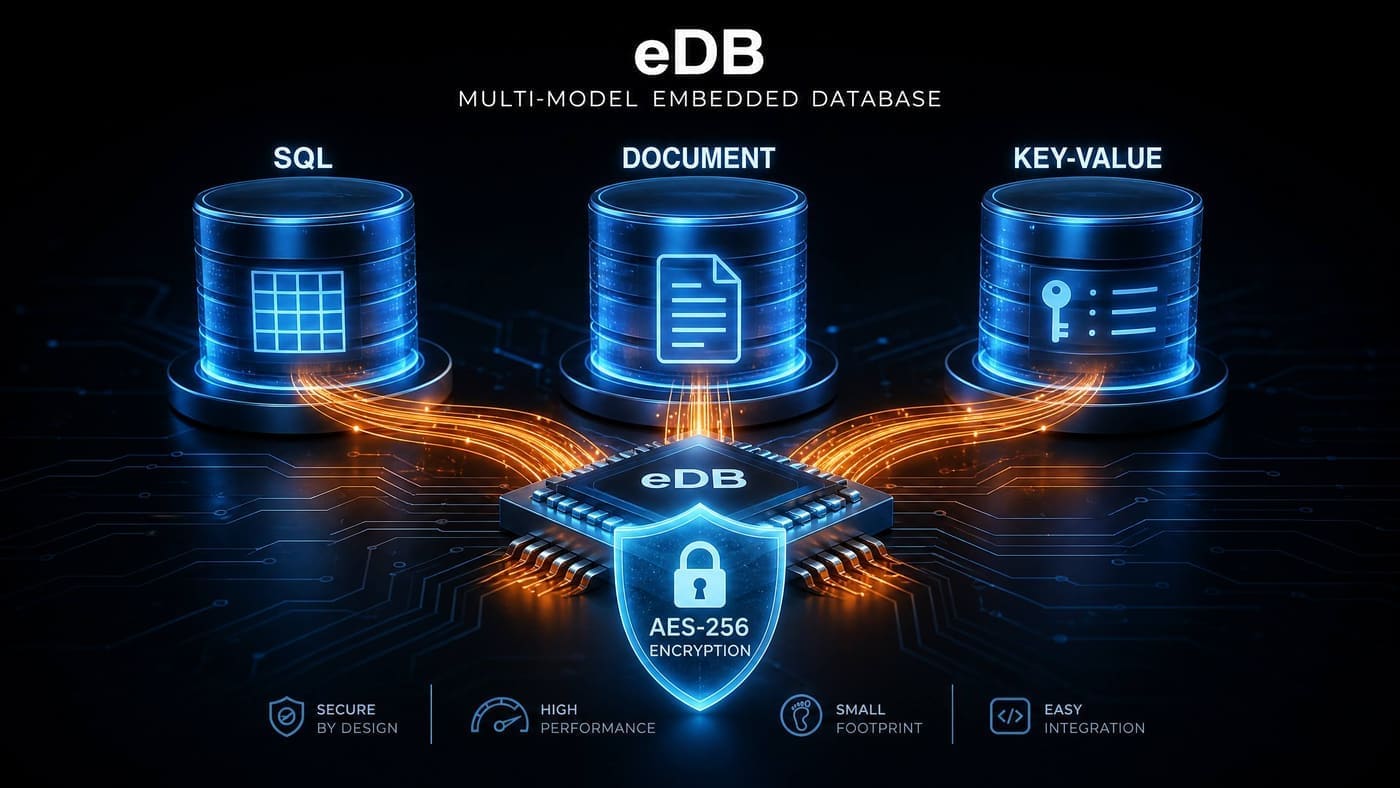
eDB — Embedded Multi-Model Database
SQL · Document · Key-Value · AES-256 Encrypted
A multi-model embedded database for EoS devices. Supports SQL, document (JSON), and key-value stores in a single engine — with AES-256 at-rest encryption rooted in the eBoot chain of trust, indexed lookups across all three models, and a < 64 KB footprint.
For a shorter introduction to eDB, see the eDB overview. This page is the engineering detail.
How It Works
Step-by-step flow — from initialization to output.
Open a Database
eDB databases are single-file stores on flash or SD card. Open with edb_open(), passing the encryption key derived from the eBoot chain of trust. eDB automatically creates the file if it doesn't exist.
// Open encrypted eDB database
#include <edb/edb.h>

// Key derived from eBoot TPM measurement
uint8_t key[32];
eboot_derive_key(key, "edb_sensor_log");

edb_t db = edb_open("/flash/sensor.edb", key);Create Tables (SQL Model)
Use the SQL interface for structured, relational data. eDB supports a subset of SQLite-compatible SQL: CREATE TABLE, INSERT, SELECT, UPDATE, DELETE, and JOIN.
edb_exec(db,
    "CREATE TABLE IF NOT EXISTS readings ("
    "  id       INTEGER PRIMARY KEY AUTOINCREMENT,"
    "  ts       INTEGER NOT NULL,"
    "  device   TEXT    NOT NULL,"
    "  temp_c   REAL,"
    "  hum_pct  REAL"
");");Insert and Query Data
Insert sensor readings and query them with SQL. eDB uses a B-tree index for O(log n) lookups and supports prepared statements to avoid SQL injection.
// Insert a reading
edb_stmt_t ins = edb_prepare(db,
    "INSERT INTO readings (ts, device, temp_c, hum_pct) "
    "VALUES (?, ?, ?, ?)");
edb_bind_int(ins, 1, eos_time_ms());
edb_bind_text(ins, 2, "node-42");
edb_bind_real(ins, 3, 23.5f);
edb_bind_real(ins, 4, 60.2f);
edb_step(ins);

// Query last 100 readings
edb_stmt_t q = edb_prepare(db,
    "SELECT ts, temp_c FROM readings ORDER BY ts DESC LIMIT 100");
while (edb_step(q) == EDB_ROW) {
    printf("ts=%lld temp=%.1f\n",
           edb_column_int64(q, 0),
           edb_column_real(q, 1));
}Use Document Store for Flexible Data
For schema-less data (device configs, AI model metadata, user preferences), use the document store. Documents are JSON objects stored in named collections.
// Store device config as JSON document
edb_doc_t cfg = edb_doc_new();
edb_doc_set_str(cfg, "firmware_version", "1.2.0");
edb_doc_set_int(cfg, "sample_rate_hz", 1000);
edb_doc_set_bool(cfg, "encryption_enabled", true);
edb_collection_insert(db, "device_config", cfg);

// Retrieve it
edb_doc_t loaded = edb_collection_find_one(db, "device_config",
                                             "firmware_version", "1.2.0");
Usage Examples
Real-world scenarios showing eDB in action.
An industrial sensor node logging 1,000 readings/second to eDB on internal flash with AES-256 encryption.
// High-throughput sensor logger
#include <edb/edb.h>

void logger_task(void *arg) {
    uint8_t key[32];
    eboot_derive_key(key, "sensor_log");
    edb_t db = edb_open("/flash/log.edb", key);

    edb_exec(db, "CREATE TABLE IF NOT EXISTS log "
                 "(ts INTEGER, ch INTEGER, val REAL)");

    edb_stmt_t ins = edb_prepare(db,
        "INSERT INTO log VALUES (?, ?, ?)");

    for (;;) {
        // Batch insert 100 readings per transaction
        edb_begin(db);
        for (int i = 0; i < 100; i++) {
            sensor_reading_t r = sensor_read_next();
            edb_bind_int(ins, 1, r.timestamp);
            edb_bind_int(ins, 2, r.channel);
            edb_bind_real(ins, 3, r.value);
            edb_step(ins);
            edb_reset(ins);
        }
        edb_commit(db);
        eos_task_delay_ms(100);
    }
}
Features
The shape of eDB at a glance.
SQL Interface
SQLite-compatible SQL: CREATE, INSERT, SELECT, UPDATE, DELETE, JOIN. Prepared statements prevent injection.
Document Store
Schema-less JSON document collections for flexible, evolving data structures.
Key-Value Store
O(1) KV store for configuration, counters, and flags. Atomic compare-and-swap.
AES-256 Encryption
At-rest encryption with keys derived from the eBoot chain of trust. Data is device-bound.
Indexed Queries
B-tree index for SQL, hash index for KV, and inverted index for document full-text search — no full-table scans for typical embedded workloads.
ACID Transactions
Full ACID guarantees with write-ahead logging. Safe across power failures.
< 64 KB Footprint
The full SQL + document + KV engine fits in 64 KB of flash.
Wear Leveling
Built-in flash wear leveling extends storage lifetime on NOR and NAND flash.
Role in the EoS Ecosystem
Why eDB matters — and what breaks without it. See how the pieces fit together in the EmbeddedOS ecosystem overview.
eDB is the persistent storage layer of the EoS ecosystem. Every component that needs to store data beyond a reboot — sensor logs, AI model metadata, user configurations, device state, health records — uses eDB. Its AES-256 encryption rooted in the eBoot chain of trust means that data is only readable on the device that created it, making eDB the right choice for medical, financial, and defense applications. The multi-model interface (SQL + document + KV) means developers don't need to choose between structured and flexible storage — eDB handles both.
Depends On
Enables / Powers
Open source on GitHub
MIT licensed and developed in the open. Issues, discussions, and pull requests welcome.
Every EmbeddedOS repository, with install commands, is listed on the downloads page.
In the EoS stack
eDB is highlighted in the layer below.
Pairs well with
Sibling components that eDB commonly works alongside.
Technical Specifications
| Query Models | SQL (SQLite-compatible), Document (JSON), Key-Value |
| Encryption | AES-256-GCM at rest; key derived from eBoot TPM measurement |
| Index Structure | B-tree for SQL; hash index for KV; inverted index for document full-text search |
| Transaction Model | ACID with write-ahead logging (WAL) |
| Query Path | Indexed (B-tree for SQL, hash for KV, inverted for document search); actual latency depends on storage medium and workload |
| Engine Footprint | < 64 KB flash (SQL + document + KV) |
| Max Database Size | Limited by storage medium; tested to 32 GB |
| Supported Storage | NOR flash, NAND flash, eMMC, SD card, RAM (volatile) |
| License | MIT |