
Inside EmbeddedOS
Eight distinct interactive 3D diagrams — each using a different visual model to best represent its product's architecture. From a CAD drawing that builds into a complete product, to layered OS stacks, radial sensor fusion hubs, and dependency trees.
The reference device as a CAD drawing: a bare printed circuit board rendered blueprint-style, before any architecture stage is built.
CAD to Product Walkthrough
One sensor board, built stage by stage: a bare CAD drawing gains sensor modules, secure-boot parts, the EoS SoC, IPC and storage, a display and app layer, an on-device AI accelerator, and finally actuator drivers — until it is a complete, powered product. Every step names the real architecture stage behind it, with maturity badges distinguishing available projects from research and plans.

Newcomers can watch the platform become a product — and, just as importantly, see what is already built versus what is still research. That honesty is what makes the platform worth evaluating.
Full EmbeddedOS Stack
The complete EmbeddedOS ecosystem shown as an interconnected node matrix — from open KiCad hardware designs through the secure bootloader, real-time kernel, AI/neural services, and up to 60+ productivity and service applications.
This unified stack means a single team can build a complete embedded product — from PCB design to shipping apps — without switching vendors or ecosystems. Every layer is MIT-licensed and open-source.
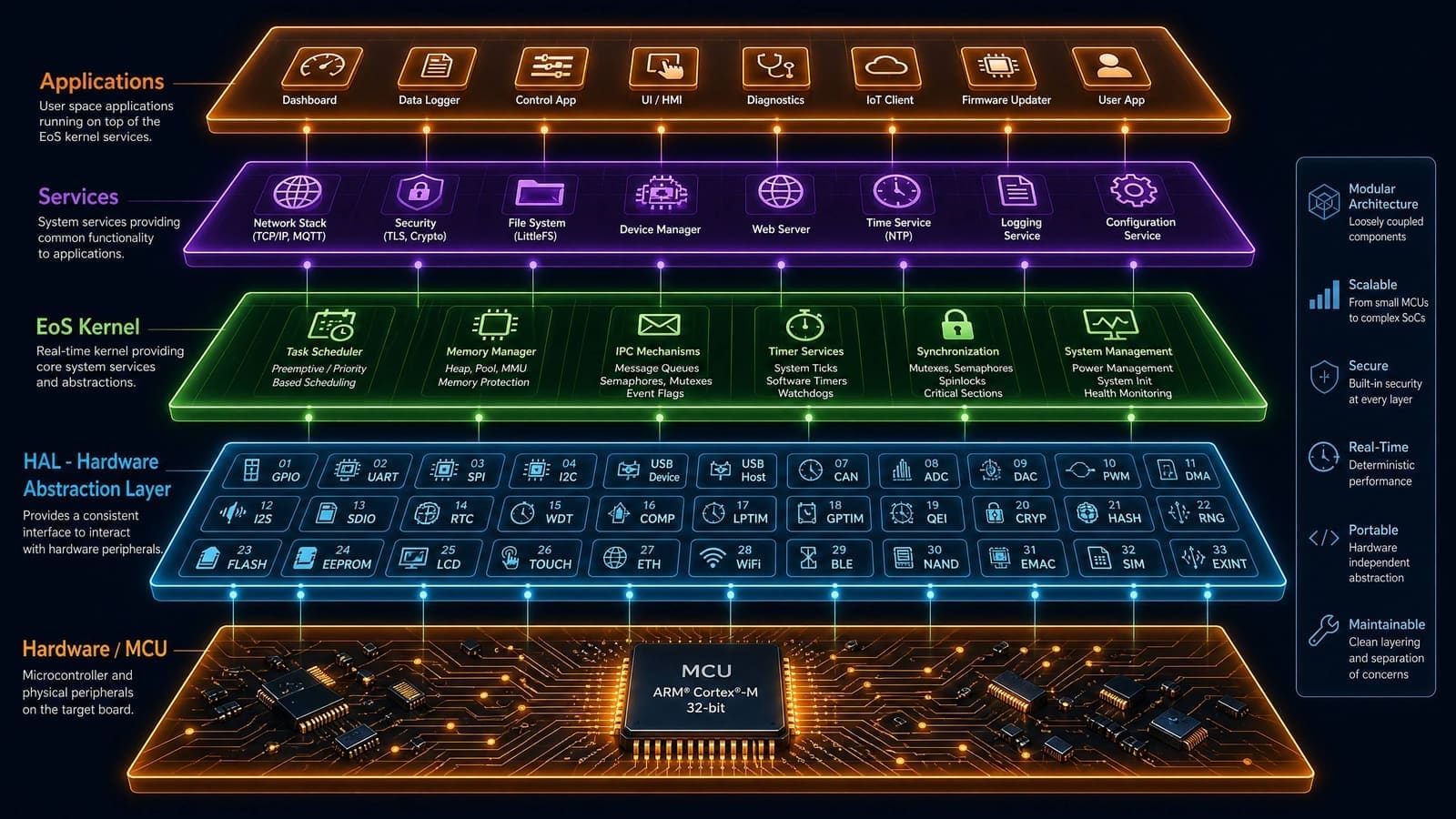
EoS Kernel Architecture
The EoS kernel sits above the Hardware Abstraction Layer (HAL), providing deterministic fixed-priority preemptive scheduling, memory management, virtual filesystem, and IPC. Services like EAI, ENI, EIPC, and eDB run as isolated processes above the kernel.
A real-time kernel with hard deadline guarantees is critical for medical devices, industrial controllers, and aerospace systems where a missed deadline can mean patient harm or equipment failure.
eBoot Secure Boot Chain
The 5-stage verified boot pipeline flows left to right: an immutable ROM bootstraps eBoot, which performs TPM 2.0 attestation, Ed25519 signature verification, A/B OTA slot selection, and hands off to the EoS kernel entry point.

Secure boot prevents malicious firmware from running on medical implants, industrial PLCs, and connected vehicles — protecting both patients and critical infrastructure from supply-chain attacks.
ENI / EAI Neural Pipeline
The research architecture places EAI at the hub with configuration-specific electrode arrays, acquisition front ends, spike-sorting DSP, and experimental output streams. Channel count, sample rate, and resolution depend on the attached hardware.
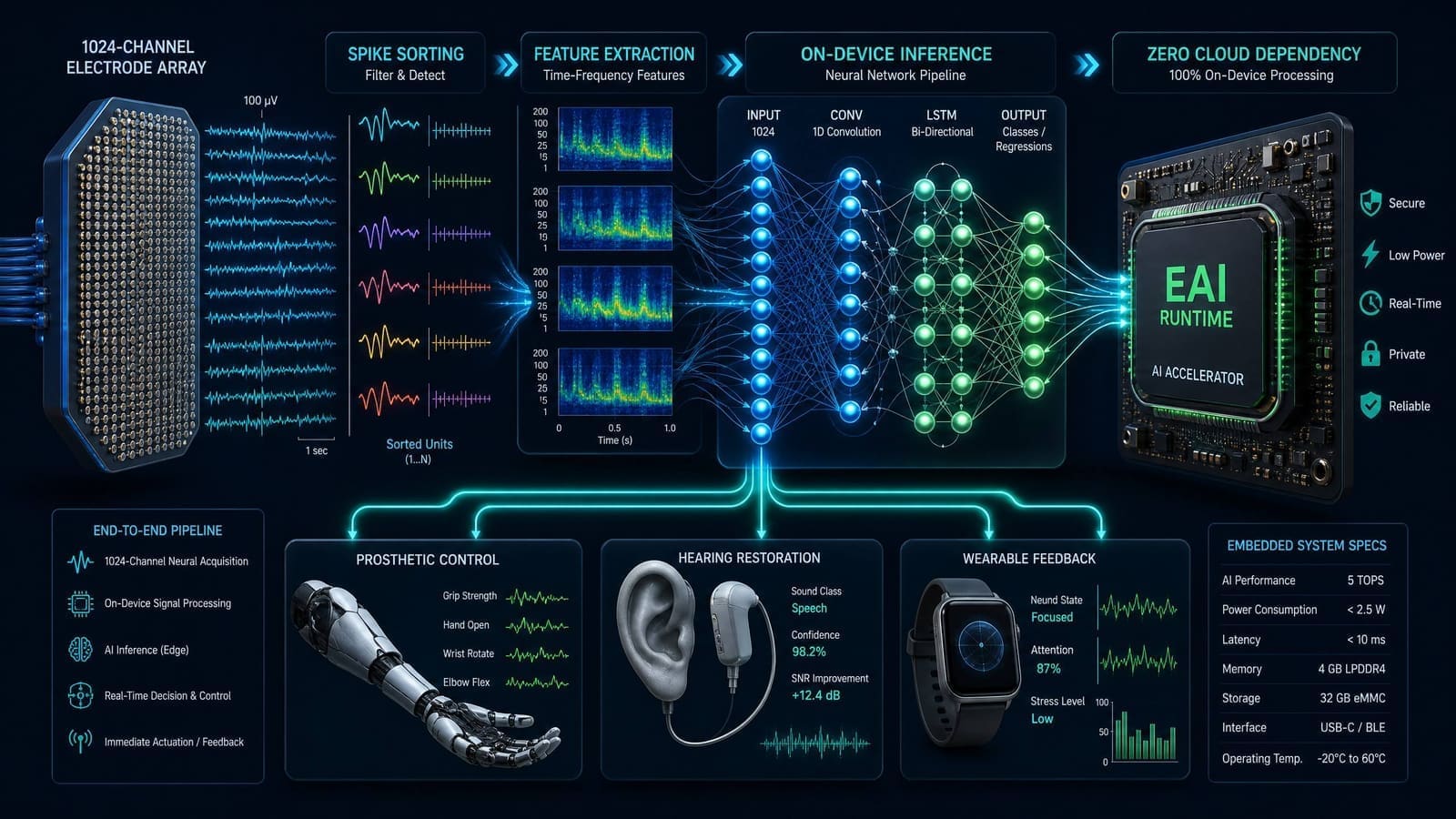
On-device neural inference is being studied for brain-computer interface research. Prosthetic control and neurostimulation are research applications that require independent clinical validation and regulatory approval.
eOffice Suite Architecture
The eOffice dependency tree shows how 11 productivity apps (eDocs, eSheets, eSlides, eMail, eDrive…) are built on a CRDT collaboration layer with eBot AI, backed by EoS services (EIPC, eDB, EAI) and the kernel's process isolation.
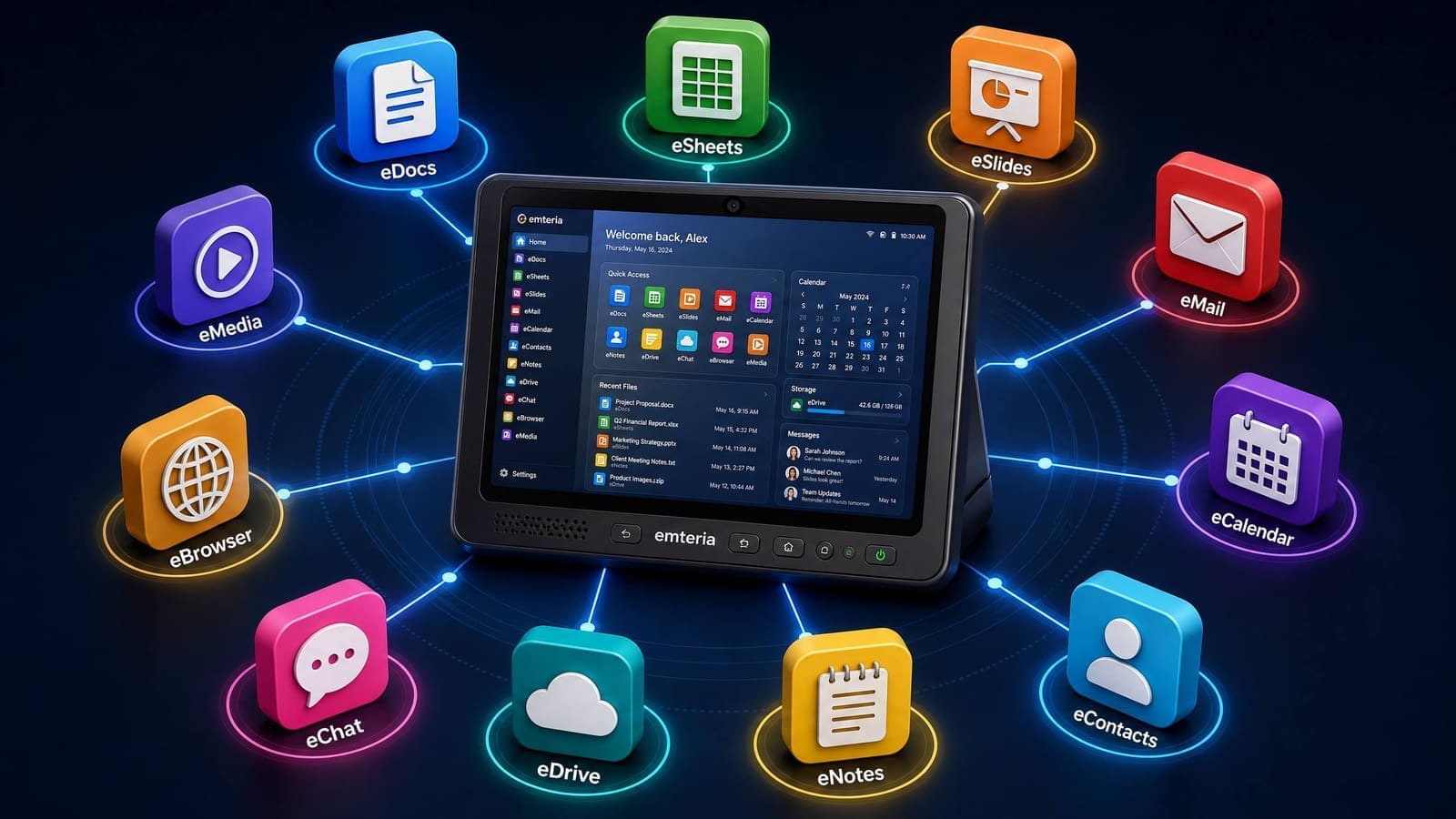
A full productivity suite running natively on embedded hardware means remote field workers, medical staff, and industrial operators can work offline without depending on cloud connectivity.
eDB Multi-Model Database
eDB's query pipeline flows from the unified REST/tRPC/WebSocket API through three storage engines (SQL with B-tree WAL, JSON/BSON document store, AES-256 key-value cache) down to the flash/NVMe storage layer — all in under 512KB flash.
Embedded devices need a database that fits in flash memory, survives power loss, and encrypts sensitive patient or industrial data — without requiring a separate database server process.
eRadar360 Sensor Fusion
The Extended Kalman Filter fusion engine sits at the hub, with 77 GHz FMCW radar, LiDAR, and camera sensors orbiting as live data streams. YOLO-nano perception AI (EAI INT4) processes fused data for object classification and trajectory prediction.
Multi-sensor fusion running on a single embedded SoC dramatically reduces the cost and complexity of autonomous vehicle perception — making ADAS accessible to mid-range vehicles and agricultural robots.
All Architecture Diagrams
Each diagram uses a different 3D visualization mode to best represent its product's structure. Click any card to open it in the interactive viewer above.
6 Visualization Modes
Each diagram type is chosen to match the product's actual architecture pattern.
Horizontal slabs showing OS layers from hardware to apps. Best for kernel and platform architectures.
Left-to-right sequential stages with arrows. Best for boot chains and query processing paths.
Central hub with orbiting nodes. Best for inference engines and sensor fusion systems.
Top-down hierarchy showing how components depend on each other. Best for app suites.
3D grid of glowing nodes. Best for showing the full ecosystem of products at once.
Seven architecture stages as one connected 3D map with maturity badges and documented links. Best for seeing how the whole platform fits together.
Why Donors Fund This Research
Every layer of the EmbeddedOS stack has real-world impact on safety, health, and freedom.
Medical Device Safety
EoS + eBoot + ENI power medical implants and health monitors. Your donation funds the security audits that keep patients safe.
Neural Interface Research
The ENI/EAI pipeline could restore movement to paralyzed patients. Donations fund hardware bring-up on new neural recording platforms.
Open Hardware Freedom
All 15 eCAD hardware categories are open KiCad designs. Donations fund new board designs and manufacturing test coverage.
Education & Books
14 technical books covering every layer of the stack — free forever. Donations fund authors, editors, and translation into 5 languages.
501(c)(3) nonprofit · 0% platform fees · Tax-deductible
The components
Every part of EmbeddedOS is a separate, independently versioned repository. The grouping below follows the path a device takes at runtime — hardware, boot, operating system, communication, on-device AI, applications — with the development tooling that builds it last.
Each status is the word that component’s own repository uses to describe itself. Several are experimental or planned, and are labelled as such rather than presented as finished.
Hardware designs
eCAD-Hardware-Products
Design / ConceptHardware and PCB CAD design collection organised by application domain, with datasheets, BOMs, power-budget scripts and some KiCad schematics.
Boot and firmware
eBoot
Available projectTwo-stage secure bootloader.
eFirmware
EarlyFirmware image toolkit: build, sign-slot, inspect and verify the firmware containers eBoot loads.
Operating system
EoS
ExperimentalMulti-platform embedded OS framework in C11: RTOS kernel, HAL with host and bare-metal backends, driver framework, networking, power and runtime services.
eNet
PlannedNetworking subsystem for EmbeddedOS: TCP/IP, UDP, DHCP, DNS, MQTT, CoAP, discovery.
eSec
PlannedSecurity framework for EmbeddedOS: crypto abstraction, key management, device identity, attestation.
Communication
eIPC
Available projectTransport-agnostic inter-process communication library in Go.
On-device AI
eAI
Experimental / ResearchOn-device AI layer in C.
eNI
Experimental / ResearchNeural-interface adapter in C.
eosllm
Experimental / ResearchOn-device LLM inference engine in portable ISO C99.
Applications and data
eDB
Available projectEmbedded multi-model database.
eBrowser
Available projectPrivacy-oriented web browser in C11 for embedded targets and desktops.
eOffice
Available projectOpen-source office suite as a TypeScript/React monorepo.
eApps
Available projectUnified marketplace and monorepo for EoS applications across native, desktop, mobile, web, browser-extension, dev-tool, CLI and enterprise categories.
Development tooling
ebuild
Available projectUnified embedded build system in Python.
EoSim
Available projectSimulation and validation platform in Python, with a native simulation engine plus QEMU and Renode backends.
EoStudio
Available projectPython development and design platform: a visual editor and design suite with multi-target code generation, driven from a single CLI entry point.
eFlow
PlannedVisual programming and dataflow authoring for EmbeddedOS, layered on EoStudio and ebuild.
18 components. Anything not listed here does not exist as a repository yet.